Coal-fired power stations in Australia: AEMO July 2026
Eraring in New South Wales is the largest NEM coal station at 2,880 MW and its owner expects to close it in 2029. All 15 coal stations in AEMO's 31 July 2026 release, 21,335 MW, are operating.
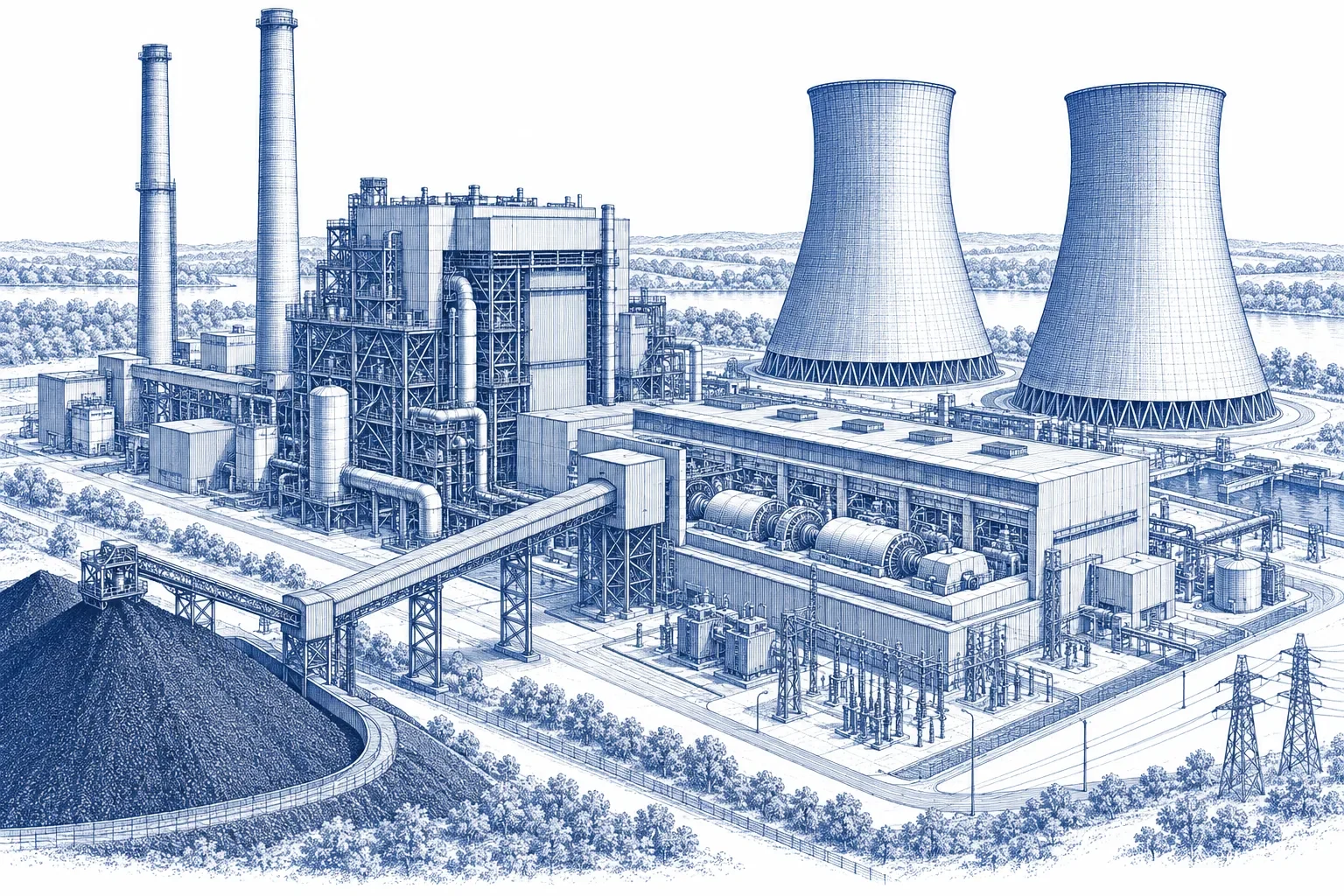
Eraring in New South Wales is Australia’s largest coal-fired power station, at 2,880 MW of reported nameplate capacity in AEMO’s NEM Generation Information release of 31 July 2026, and its owner expects to close it in 2029.1 The release lists 15 coal stations in the National Electricity Market, 21,335 MW in all, and every one is still operating.1 Owners’ expected closure years run from Yallourn W in 2028 to Millmerran in 2051, with Callide C recorded at 2200.1 The same release sits behind our ranking of battery storage sites.
TL;DR
- The first three closures are the three stations AEMO classes as Announced Withdrawal: Yallourn W in 2028, then Eraring and Gladstone in 2029. Together they hold 6,010 MW, 28.2 per cent of NEM coal capacity.1
- On the owners’ submitted years, stations holding 12,955 MW, 60.7 per cent of the fleet, close their last unit by 2035.1
- New South Wales holds the most coal capacity, 8,345 MW across four stations. Queensland has the most stations, eight, and four of the six stations with a closure year after 2037.1
- Two submitted years fall after 2050: Millmerran at 2051 and Callide C at 2200.1 The 2200 entry is a recorded value, not a closure plan.
- Other lists print different megawatts and dates because they use a different capacity measure, an older owner announcement or a wider map that includes Western Australia.
How this ranking was built
Glamdring Research ranked every coal station in AEMO’s NEM Generation Information release of 31 July 2026 on one field: reported nameplate capacity, Aggregated Nameplate Capacity (MW AC), from the Generator Information sheet of the release file.1 Rows with Technology Type set to Coal are in, and rows with the status Withdrawn are out.1 Generating-unit rows that share a site name and region were summed into one site, which leaves 15 stations.1
Closure dates come from the release’s unit-level Expected Closure Year field, which AEMO also publishes as a standalone file.1 Where a station’s units carry different years, the table shows the earliest and latest, so Stanwell reads 2043-2046.1 The years are those submitted by owners.1
The extract records the station count after the merge.1 It doesn’t record the raw coal row count or how many withdrawn rows were removed, so those steps carry no figure here. How Glamdring handles registry data is set out in our methodology.
Which coal power stations are the largest?
Eraring is the largest coal-fired power station in the NEM, at 2,880 MW, followed by Bayswater at 2,715 MW and Loy Yang A at 2,210 MW, in AEMO’s July 2026 release.1 Bayswater is the largest station in AEMO’s In Service class, because Eraring carries an announced withdrawal.1 Every figure is a registry value, reported rather than measured.
| # | Station | State | Coal type | Status | Nameplate MW (AC) | Expected closure year |
|---|---|---|---|---|---|---|
| 1 | Eraring | New South Wales | Black Coal | Announced Withdrawal | 2,880 | 2029 |
| 2 | Bayswater | New South Wales | Black Coal | In Service | 2,715 | 2033 |
| 3 | Loy Yang A Power Station | Victoria | Brown Coal | In Service | 2,210 | 2035 |
| 4 | Gladstone | Queensland | Black Coal | Announced Withdrawal | 1,680 | 2029 |
| 5 | Stanwell | Queensland | Black Coal | In Service | 1,460 | 2043-2046 |
| 6 | Yallourn W | Victoria | Brown Coal | Announced Withdrawal | 1,450 | 2028 |
| 7 | Mt Piper | New South Wales | Black Coal | In Service | 1,430 | 2040 |
| 8 | Tarong | Queensland | Black Coal | In Service | 1,400 | 2036-2037 |
| 9 | Vales Point B | New South Wales | Black Coal | In Service | 1,320 | 2033 |
| 10 | Loy Yang B | Victoria | Brown Coal | In Service | 1,200 | 2047 |
| 11 | Millmerran Power Plant | Queensland | Black Coal | In Service | 852 | 2051 |
| 12 | Callide C | Queensland | Black Coal | In Service | 844 | 2200 |
| 13 | Kogan Creek | Queensland | Black Coal | In Service | 744 | 2042 |
| 14 | Callide B | Queensland | Black Coal | In Service | 700 | 2031 |
| 15 | Tarong North | Queensland | Black Coal | In Service | 450 | 2037 |
Every row comes from the same release and the same two fields.1
The three brown-coal stations are all in Victoria and hold 4,860 MW; the other 12 burn black coal and hold 16,475 MW.1 The owner field names Stanwell Corporation Limited on three stations, Stanwell, Tarong and Tarong North, for 3,310 MW, more than any other single owner name in the list.1 Two AGL-named companies are registered against Bayswater and Loy Yang A, which together hold 4,925 MW.1
Size and closure date don’t track each other. All four of the largest stations close by 2035, while Millmerran and Callide C, 11th and 12th by size, carry the latest years in the list.1
When do owners expect each coal station to close?
Yallourn W is first, in 2028, followed by Eraring and Gladstone in 2029, Callide B in 2031, and Bayswater and Vales Point B in 2033, on the expected closure years owners submitted to AEMO for its July 2026 release.1 The closure years are owner submissions, reported not guaranteed. The owner decides when a coal station closes, and NEM owners must notify AEMO at least 3.5 years before the intended closure date.2
| Order | Station | State | Owner (as registered) | Nameplate MW (AC) | Expected closure year |
|---|---|---|---|---|---|
| 1 | Yallourn W | Victoria | EnergyAustralia Yallourn Pty Ltd | 1,450 | 2028 |
| 2 | Eraring | New South Wales | Origin Energy Eraring Pty Ltd | 2,880 | 2029 |
| 3 | Gladstone | Queensland | Gladstone Power Station Participants | 1,680 | 2029 |
| 4 | Callide B | Queensland | CS Energy | 700 | 2031 |
| 5 | Bayswater | New South Wales | AGL Macquarie Pty Limited | 2,715 | 2033 |
| 6 | Vales Point B | New South Wales | Delta Electricity | 1,320 | 2033 |
| 7 | Loy Yang A Power Station | Victoria | AGL Loy Yang Marketing Pty Ltd | 2,210 | 2035 |
| 8 | Tarong | Queensland | Stanwell Corporation Limited | 1,400 | 2036-2037 |
| 9 | Tarong North | Queensland | Stanwell Corporation Limited | 450 | 2037 |
| 10 | Mt Piper | New South Wales | EnergyAustralia NSW Pty Ltd | 1,430 | 2040 |
| 11 | Kogan Creek | Queensland | Kogan Creek Power Station Pty Ltd | 744 | 2042 |
| 12 | Stanwell | Queensland | Stanwell Corporation Limited | 1,460 | 2043-2046 |
| 13 | Loy Yang B | Victoria | Five registered companies, including LYB Ventures Australia Pty Ltd and Gippsland Power Pty Ltd | 1,200 | 2047 |
| 14 | Millmerran Power Plant | Queensland | Millmerran Power Partners | 852 | 2051 |
| 15 | Callide C | Queensland | Joint Venture; Callide Energy Pty Ltd and IG Power (Callide) Ltd. | 844 | 2200 |
The order is the release’s; the owner of Loy Yang B is shortened from five registered company names.1
The early years carry the weight. Stations holding 6,010 MW close by 2029, and stations holding 12,955 MW, 60.7 per cent of the fleet, have closed their last unit by 2035 on the submitted years.1 Add Tarong and Tarong North and the figure reaches 14,805 MW by 2037.1 The remaining 6,530 MW sits in six stations with years from 2040 onward.1
The same years also reorder the top of the list. If each station closes in its recorded year, Bayswater becomes the largest coal station after Eraring’s 2029, Loy Yang A after Bayswater’s 2033, and Stanwell after Loy Yang A’s 2035.1
Callide C’s 2200 is the value the file holds. Wikipedia’s list, citing AEMO, shows Callide C’s closure as “Not Announced”, which is the safer reading: no closure year has been set.3
Submitted years move. Wikipedia’s list cites a 2022 ABC report that Origin would shut Eraring by 2025.3 The Guardian reported in January 2026 that Eraring would stay open for an additional two years until 2029.4 The Net Zero Economy Authority says owners extend stations for their own commercial or operational reasons, including when not enough renewable supply is connected.2 Confirm a station’s date against the owner’s latest notice before relying on it.
What does Announced Withdrawal mean?
Announced Withdrawal means an operating plant with a closure announced.1 In the release’s status classes, In Service and Announced Withdrawal are operating capacity; every other class is not yet built.1 All 15 coal stations sit in one of those two classes, so all 21,335 MW is operating capacity.1
Three stations carry the status in the July 2026 release: Eraring at 2,880 MW, Gladstone at 1,680 MW and Yallourn W at 1,450 MW.1 They’re also the three earliest closures in the list, 2028 and 2029.1 Callide B, at 2031, has the earliest year of any In Service station but doesn’t carry the status in this release.1
A reader totting up “in service” coal from AEMO’s status column will get 15,325 MW, because that column leaves out the 6,010 MW under announced withdrawal.1 Both figures are correct for their own definition. For the question “how much coal is running today”, the answer is the full 21,335 MW.
Which states have the most coal power capacity?
New South Wales holds the most coal capacity in AEMO’s July 2026 release, 8,345 MW across four stations, 39.1 per cent of the NEM total.1 Queensland follows at 8,130 MW across eight stations and Victoria at 4,860 MW across three.1
| State | Stations | Nameplate MW (AC) | In Service class MW | Announced Withdrawal MW | Share of NEM coal |
|---|---|---|---|---|---|
| New South Wales | 4 | 8,345 | 5,465 | 2,880 | 39.1% |
| Queensland | 8 | 8,130 | 6,450 | 1,680 | 38.1% |
| Victoria | 3 | 4,860 | 3,410 | 1,450 | 22.8% |
| NEM total | 15 | 21,335 | 15,325 | 6,010 | 100% |
The first three figure columns are the release’s; the withdrawal column and the shares are Glamdring’s arithmetic on them.1
The states run on different clocks. New South Wales has submitted years for all four stations by 2040, and three of them, 6,915 MW, by 2033.1 Victoria’s brown-coal fleet loses Yallourn W in 2028 and Loy Yang A in 2035, leaving Loy Yang B to 2047.1 Queensland holds most of the long tail: Kogan Creek, Stanwell, Millmerran and Callide C all carry years after 2040.1
South Australia, Tasmania and the Australian Capital Territory have no operating coal stations, according to Wikipedia’s list.3 Western Australia’s coal stations sit outside the NEM and outside this release.3
Why do other published figures disagree?
Other coal station lists disagree with AEMO’s release because they use a different capacity measure, an older closure announcement or a wider geography. Wikipedia’s list shows all three.3
On capacity, Wikipedia’s “Max. capacity” column gives Bayswater 2,640 MW, Loy Yang B 1,050 MW and Callide C 810 MW, against AEMO’s nameplate figures of 2,715 MW, 1,200 MW and 844 MW.3,1 Stanwell Corporation describes Tarong North as a single 443 MW unit; the release records 450 MW.5,1 A different field produces a different number, and neither is a measured output.
On dates, Wikipedia gives Callide B a 2028 closure, citing a 2019 report, while AEMO’s July 2026 release records 2031.3,1 Wikipedia gives Gladstone “2035, potential early closure in 2029”; the release records 2029 and the Announced Withdrawal status.3,1 Where Wikipedia shows one year, AEMO’s unit-level field can show a range, as with Stanwell’s 2043-2046 against Wikipedia’s 2046.3,1
On scope, Australia Beyond Coal’s map says Australia has 19 coal-burning power stations, but that page was last updated in October 2020 and covers the whole country.6 Wikipedia lists Collie, Muja and Bluewaters in Western Australia, none of which is in the NEM release.3 Any national count that includes Western Australia runs higher than AEMO’s 15.
What the ranking cannot tell you
The release covers the National Electricity Market only, so Western Australia’s coal stations are out of scope.1 It doesn’t say when a unit will close within its year, how often a station runs, or what it emits. The capacity figure is a registered rating, not a measure of output.
Expected closure years are owner submissions, and owners have moved them before.2 The ranking can’t say whether a year will hold. It also can’t show what changed since AEMO’s previous release, because the extract used here covers July 2026 alone.
Every figure is dated to the 31 July 2026 release, and the ranking changes when AEMO publishes the next one. The revision will carry a change note and its sources: subscribe to the email briefing.
Frequently asked questions
How many coal-fired power stations are there in Australia?
AEMO’s July 2026 release lists 15 coal-fired power stations in the National Electricity Market: four in New South Wales, eight in Queensland and three in Victoria.1 Western Australia has more outside the NEM; Wikipedia lists Collie, Muja and Bluewaters.3
Are there any coal-fired power stations left?
Yes. All 15 NEM coal stations in AEMO’s July 2026 release are operating, with 21,335 MW of nameplate capacity between them.1 Three of them, Eraring, Gladstone and Yallourn W, have announced their withdrawal.1
Is Australia phasing out coal power stations?
The Net Zero Economy Authority says Australia’s coal-fired power stations will gradually close as the country moves to net zero by 2050, with each owner deciding its own closure date.2 On the years owners submitted for AEMO’s July 2026 release, stations holding 60.7 per cent of NEM coal capacity close by 2035, and two, Millmerran and Callide C, carry years after 2050.1
When was the last coal-fired power station built in Australia?
Wikipedia’s list names Bluewaters in Western Australia, commissioned in 2009, as the most recent, and Kogan Creek, commissioned in 2007, as the newest in the NEM states.3 The same list says a new coal-fired station is unlikely ever to be built in Australia, and Stanwell Corporation calls a new plant unlikely too.3,5
Sources checked
Company-owned pages establish what a company says. They do not prove a market conclusion. Each source is dated so readers can judge each claim.