Renewable energy companies in Australia: AEMO July 2026
Snowy Hydro Ltd owns the most in-service renewable capacity in AEMO's 31 July 2026 NEM Generation Information release, 3,821.5 MW of conventional hydro.
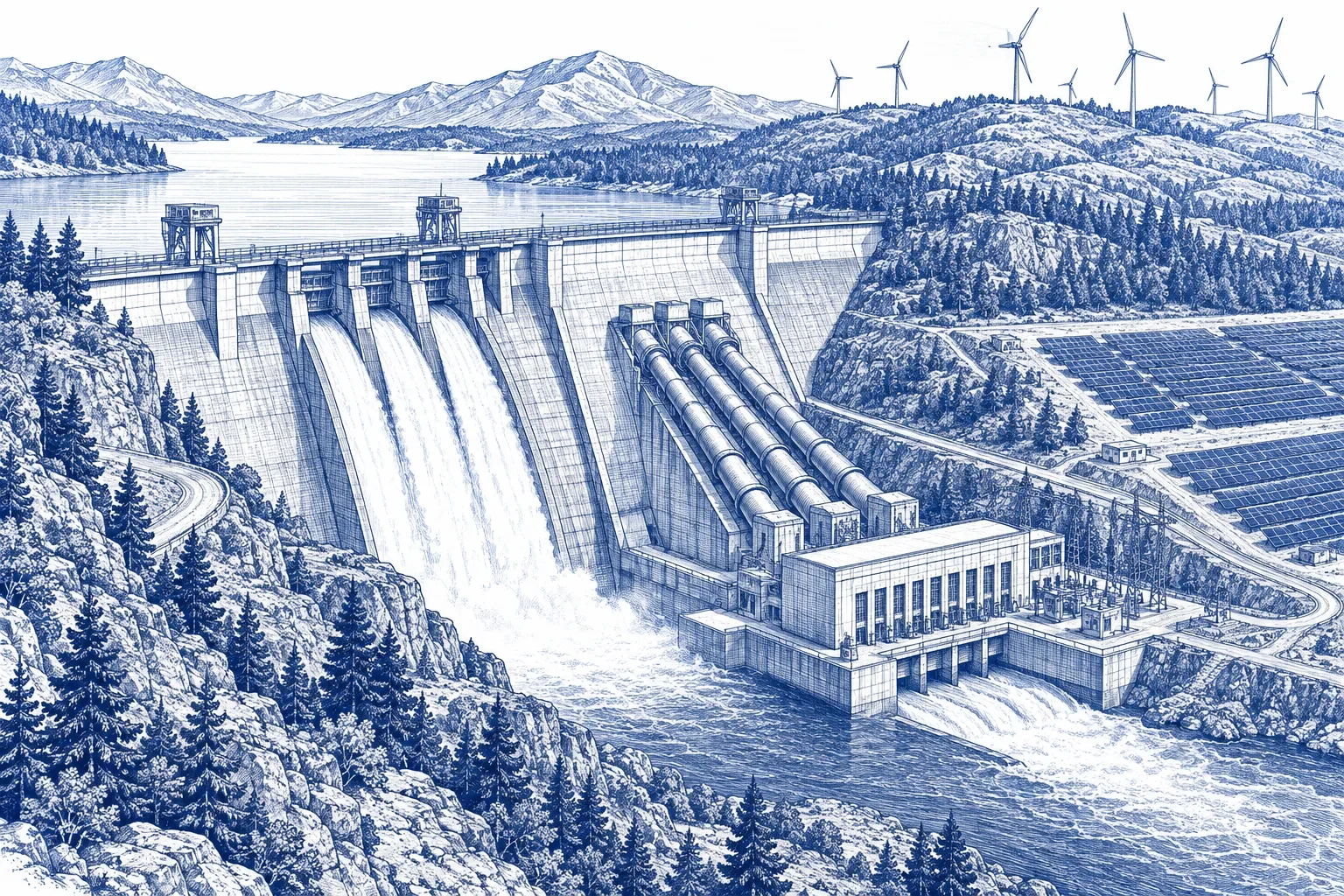
Snowy Hydro Ltd owns the most operating renewable generation in Australia’s National Electricity Market (NEM): 3,821.5 MW of in-service conventional hydro capacity across 8 sites, according to AEMO’s NEM Generation Information release of 31 July 2026.1 Hydro-Electric Corporation is second with 2,276.6 MW of hydro, and ACEN AUSTRALIA, the largest solar owner, is third with 800 MW.1
Each owner appears exactly as AEMO’s owner field records it, so one corporate group can show up under more than one name.1
TL;DR
- Conventional hydro decides the top of the list. Snowy Hydro Ltd, Hydro-Electric Corporation and AGL Hydro Partnership own 6,875.1 MW of the top ten’s 11,029.4 MW.1
- Below the hydro owners, wind is the common holding. Of the 40 largest owners, 20 own wind only, 14 own solar only and 3 own both.1
- The owner record is usually a project company, not a parent group: 27 of the 40 largest owners are recorded against a single site.1
- Related entities are not merged. Tilt Renewables Australia Pty Ltd (509 MW) and Tilt Renewables (336 MW) rank ninth and fifteenth; summed, they would sit third.1
- Pumped hydro is excluded as storage, and batteries aren’t counted either.1 DC-rated solar figures, operator portfolios and project maps measure different things and won’t match these numbers.
How this ranking was built
We ranked site owners on one field from one release: AEMO’s NEM Generation Information for July 2026, published on 31 July 2026.1 The figures come from the release’s Generator Information sheet, and every value below is a sum of the release’s own cells.1 Our research standard explains how we source and check figures like these.
- Field: installed capacity, recorded by AEMO as Aggregated Nameplate Capacity (MW AC), in megawatts AC.1
- Inclusion: Commitment Status = In Service; Technology Type = Solar PV or Wind, or Hydro with Technology Detail Dam or Run of River.1
- Exclusions: pumped hydro excluded as storage; rows with status Withdrawn.1
- Sites: generating-unit rows sharing a site name and region are summed into one site.1
- Owners: owner as recorded, not merged. The ranking uses the Site Owner cell exactly as written, and related entities are not merged.1
- Result: 184 owners hold in-service solar, wind or conventional hydro capacity. The table shows the top 25.1
AEMO records these capacities in its register. They’re registry figures, reported rather than measured output.1
Which companies own the most operating renewable capacity in the NEM?
Glamdring Research’s count of AEMO’s 31 July 2026 release puts Snowy Hydro Ltd first with 3,821.5 MW, followed by Hydro-Electric Corporation with 2,276.6 MW and ACEN AUSTRALIA with 800 MW.1 The ranked figure is in-service solar, wind and conventional hydro nameplate capacity in MW AC, summed for each site owner as AEMO records it.1
| Rank | Site owner (as recorded) | In-service capacity (MW AC) | Solar (MW) | Wind (MW) | Hydro (MW) | Sites |
|---|---|---|---|---|---|---|
| 1 | Snowy Hydro Ltd | 3,821.5 | 0 | 0 | 3,821.5 | 8 |
| 2 | Hydro-Electric Corporation | 2,276.6 | 0 | 0 | 2,276.6 | 22 |
| 3 | ACEN AUSTRALIA | 800 | 800 | 0 | 0 | 2 |
| 4 | AGL Hydro Partnership | 777 | 0 | 0 | 777 | 10 |
| 5 | Golden Plains WF1 Pty Ltd as trustee for the Golden Plains WF1 Unit Trust | 756.4 | 0 | 756.4 | 0 | 1 |
| 6 | PARF Company 6 Pty Limited | 608.5 | 155.6 | 452.9 | 0 | 3 |
| 7 | Stockyard Hill Wind Farm Pty Ltd | 527.6 | 0 | 527.6 | 0 | 1 |
| 8 | Ratch Australia | 516 | 42.5 | 473.5 | 0 | 6 |
| 9 | Tilt Renewables Australia Pty Ltd | 509 | 0 | 509 | 0 | 2 |
| 10 | Wellington North Solar Farm Pty Ltd | 436.8 | 436.8 | 0 | 0 | 1 |
| 11 | Macarthur Wind Farm Pty Ltd and Meridian Wind Macarthur Pty Ltd | 420 | 0 | 420 | 0 | 1 |
| 12 | Western Downs Green Power Hub Pty Ltd | 400.8 | 400.8 | 0 | 0 | 1 |
| 13 | Acciona Energy Australia Global Pty Ltd | 387.8 | 387.8 | 0 | 0 | 1 |
| 14 | Culcairn Solar Farm Pty Ltd as trustee for Culcairn Solar Farm Trust | 349.6 | 349.6 | 0 | 0 | 1 |
| 15 | Tilt Renewables | 336 | 0 | 336 | 0 | 1 |
| 16 | Moorabool Wind Farm Interface Company Pty Ltd | 312 | 0 | 312 | 0 | 1 |
| 17 | FRV Australia (Walla Walla Asset Co Pty Ltd (ACN 634 728 868) as trustee for the Walla Walla Asset Trust) | 304.3 | 304.3 | 0 | 0 | 1 |
| 18 | PAREP 1 Pty Ltd | 300 | 99 | 201 | 0 | 2 |
| 19 | Berrbank Development Pty ltd | 289.8 | 0 | 289.8 | 0 | 1 |
| 20 | Wollar Solar Development Pty Ltd | 280 | 280 | 0 | 0 | 1 |
| 21 | Lake Bonney Wind Power Pty Ltd | 278.5 | 0 | 278.5 | 0 | 3 |
| 22 | Darlington Point Solar Farm Pty Ltd | 275.4 | 275.4 | 0 | 0 | 1 |
| 23 | SWF1 Operations Holdings Pty Ltd as trustee for SWF1 Hold Trust | 270 | 0 | 270 | 0 | 1 |
| 24 | Snowtown Wind Farm Stage 2 Pty Ltd | 270 | 0 | 270 | 0 | 1 |
| 25 | Limondale Sun Farm Pty Ltd | 259 | 259 | 0 | 0 | 2 |
Source: AEMO, NEM Generation Information, July 2026 (released 31 July 2026), Generator Information sheet, summed by Glamdring Research.1
Snowy Hydro Ltd’s lead is wide. Its 3,821.5 MW is more than the owners ranked third to seventh hold between them, 3,469.5 MW.1 After the fourth place the gaps close quickly: ranks five to ten run from 756.4 MW down to 436.8 MW, and a single wind or solar farm can move an owner several places.1
The names tell you what the owner field records. Most rows are companies or trusts named after one farm, such as Stockyard Hill Wind Farm Pty Ltd or Culcairn Solar Farm Pty Ltd as trustee for Culcairn Solar Farm Trust.1 Only a handful of records carry a portfolio name, among them Ratch Australia with 6 sites and AGL Hydro Partnership with 10.1
How does the solar, wind and hydro split change the order?
Hydro sets the top of the ranking, while wind and solar set everything below fourth place.1 Only three of the 40 largest owners hold conventional hydro, and all three sit in the top four.1 Across the top ten, they account for 6,875.1 MW of hydro, against 2,719.4 MW of wind and 1,434.9 MW of solar.1 ACEN AUSTRALIA is the largest solar owner at 800 MW, and Golden Plains WF1 Pty Ltd as trustee for the Golden Plains WF1 Unit Trust is the largest wind owner at 756.4 MW.1
| Technology | Largest owner (as recorded) | MW AC | Second-largest owner | MW AC |
|---|---|---|---|---|
| Hydro (Dam, Run of River) | Snowy Hydro Ltd | 3,821.5 | Hydro-Electric Corporation | 2,276.6 |
| Wind | Golden Plains WF1 Pty Ltd as trustee for the Golden Plains WF1 Unit Trust | 756.4 | Stockyard Hill Wind Farm Pty Ltd | 527.6 |
| Solar PV | ACEN AUSTRALIA | 800 | Wellington North Solar Farm Pty Ltd | 436.8 |
These technology leaders hold across all 184 owners, not just the table. The fortieth-largest owner has 200.8 MW in total, so no owner outside the top 40 can hold more than that in any one technology.1
Three owners in the top 40 hold both solar and wind. PARF Company 6 Pty Limited has 155.6 MW of solar and 452.9 MW of wind across 3 sites; Ratch Australia has 42.5 MW of solar and 473.5 MW of wind across 6 sites; PAREP 1 Pty Ltd has 99 MW of solar and 201 MW of wind across 2 sites.1 Every other owner in the top 40 holds a single technology.1
Wind owners outnumber solar owners among the largest holdings, 20 to 14 in the top 40.1 Big single solar sites still rank high. Wellington North Solar Farm Pty Ltd, Western Downs Green Power Hub Pty Ltd and Acciona Energy Australia Global Pty Ltd each hold one solar site of more than 380 MW, which puts them above 16 of the 20 wind-only owners in the top 40.1
Why are related companies listed separately?
Glamdring Research ranks each owner exactly as AEMO’s Site Owner field records it, because that field is the release’s own record and any merge would be our judgement laid on top of it.1 The cost is that one group can appear under several names. The clearest case is Tilt Renewables Australia Pty Ltd, ninth with 509 MW of wind across 2 sites, and Tilt Renewables, fifteenth with 336 MW of wind at 1 site.1 Summed, those two records come to 845 MW, which would rank third, above ACEN AUSTRALIA’s 800 MW.1
The names suggest a link. The fields we summed don’t establish one, and they don’t say which entity holds which share of a site.
Several other records share a project name without the release tying them together. Murra Warra Project Co Pty Ltd (225.7 MW) and Murra Warra II Project Co Pty Ltd as Trustee for the Murra Warra II Project Trust (209 MW) are separate owners. So are Goyder Wind Farm 1A Pty Ltd as trustee for Goyder Wind Farm 1A Trust (209 MW) and Goyder Wind Farm 1B Pty Ltd as trustee for Goyder Wind Farm 1B Trust (203.5 MW).1 One record, Macarthur Wind Farm Pty Ltd and Meridian Wind Macarthur Pty Ltd, names two companies against a single 420 MW site.1
If you need group-level exposure, treat these rows as the starting list. Confirm who controls each entity in the company’s current filings before adding records together.
Why is pumped hydro left out?
This ranking counts pumped hydro as storage, so it’s excluded; the only hydro counted is capacity AEMO records with Technology Detail Dam or Run of River.1 The hydro figures for Snowy Hydro Ltd, Hydro-Electric Corporation and AGL Hydro Partnership are therefore conventional hydro only.1 Any pumped hydro those owners hold sits outside these totals.
Storage has its own coverage in our energy storage research. Keeping it apart stops a storage asset from lifting an owner’s generation rank, and it keeps this list to plant that generates from water, wind or sun.
What does AEMO’s capacity figure measure?
The ranked figure is installed capacity in megawatts AC, recorded by AEMO as Aggregated Nameplate Capacity (MW AC), for plant with the status In Service.1 It’s a capacity rating, not the electricity a site produced over a year. AEMO records 3,821.5 MW for Snowy Hydro Ltd. That is a registry figure, not a measured output.1
Three consequences follow for anyone reading the table:
- Capacity isn’t energy. A 500 MW wind owner and a 500 MW hydro owner rank level here, whatever their annual generation.
- Status matters. Only the In Service class counts. Rows with status Withdrawn are excluded, and projects AEMO classes as not yet built fall outside the In Service filter.1
- AC is the unit. Solar farms are also described in DC terms, which gives a larger number for the same site.2
Why do other published figures disagree?
Other figures disagree because they count something else: DC panel ratings instead of AC capacity, portfolios a company operates for others instead of sites it owns, or projects at every stage instead of in-service plant.
DC versus AC. Solarig’s November 2025 press release describes Stubbo Solar as “400 MW / 520 MWp” and names ACEN Australia as its owner.2 The same site carries two ratings, and the MWp figure is the larger one. The same release puts Darlington Point at 333 MWp.2 AEMO records Darlington Point Solar Farm Pty Ltd with 275.4 MW AC at one site.1
Operated versus owned. Solarig says it has reached “2 GW in Operation and Maintenance (O&M) in Australia” and calls itself the country’s largest O&M operator by installed capacity.2 That is a company statement about plant it maintains. No owner recorded as Solarig appears among the 40 largest site owners in AEMO’s release.1
Every stage versus in service. A RenewMap capacity widget on the same RenewEconomy page shows 1,074,239.53 MW of generation capacity, labelled as an overview of utility-scale energy projects in Australia.2 The widget doesn’t state which project statuses it counts, so it can’t be set beside an in-service total.
Retailers versus generators. Some pages that rank for this search list green energy suppliers and installers by customer review ratings.3 Those lists rank suppliers on reviews, not on plant owned, so they answer a different question.
What the ranking cannot tell you
Glamdring Research’s ranking shows who is recorded as owning in-service solar, wind and conventional hydro capacity in the NEM on AEMO’s 31 July 2026 release; it can’t show corporate control, output, earnings or change over time.1
- Parent groups and equity shares. The ranking reads the Site Owner cell only. Shared ownership and parent companies need company filings.
- Energy produced. Capacity isn’t generation, and this ranking uses no output data.
- Change since the previous release. We haven’t compared this release with AEMO’s earlier one, so this edition makes no claim about which owners grew.
- Location. Sites are built from site name and region, but we haven’t published a per-owner split by state.1
- Plant outside the NEM. The release covers the National Electricity Market only.1
- The long tail. 184 owners qualify; the table shows 25. Every owner below fortieth place holds less than 200.8 MW.1
We’ll refresh this ranking when AEMO publishes its next Generation Information release. Subscribe to our research briefing to receive the updated ranking.
Frequently asked questions
Who is the largest renewable energy developer in Australia?
This ranking counts owners of in-service plant, not developers, so it can’t rank developers. On owned in-service capacity, Snowy Hydro Ltd is largest with 3,821.5 MW of conventional hydro.1 Among solar and wind owners, ACEN AUSTRALIA leads solar with 800 MW and Golden Plains WF1 Pty Ltd as trustee for the Golden Plains WF1 Unit Trust leads wind with 756.4 MW.1 Projects that are announced, committed or under construction are a different count, and this ranking leaves them out.
What are the top 5 renewable energy companies in Australia?
By in-service capacity owned in the NEM, as recorded in AEMO’s July 2026 release, the top five are Snowy Hydro Ltd (3,821.5 MW), Hydro-Electric Corporation (2,276.6 MW), ACEN AUSTRALIA (800 MW), AGL Hydro Partnership (777 MW) and Golden Plains WF1 Pty Ltd as trustee for the Golden Plains WF1 Unit Trust (756.4 MW).1 If the two Tilt Renewables records were summed, their 845 MW would place third; this ranking keeps them apart.1
Does the ranking include battery storage?
No. The ranking counts only Solar PV, Wind and conventional Hydro, so grid batteries and pumped hydro are left out.1 Our ranking of the largest battery storage sites in Australia covers grid batteries from AEMO’s Generation Information data.
Is this a list of the best renewable energy stocks?
No. The ranking measures recorded generating capacity, not company value, earnings or share performance, and it isn’t investment advice. Of the 40 largest owners, 27 are recorded against a single site, often as a project company or trust named after that site.1 A capacity ranking can’t tell you what that capacity earns.
Sources checked
Company-owned pages establish what a company says. They do not prove a market conclusion. Each source is dated so readers can judge each claim.